
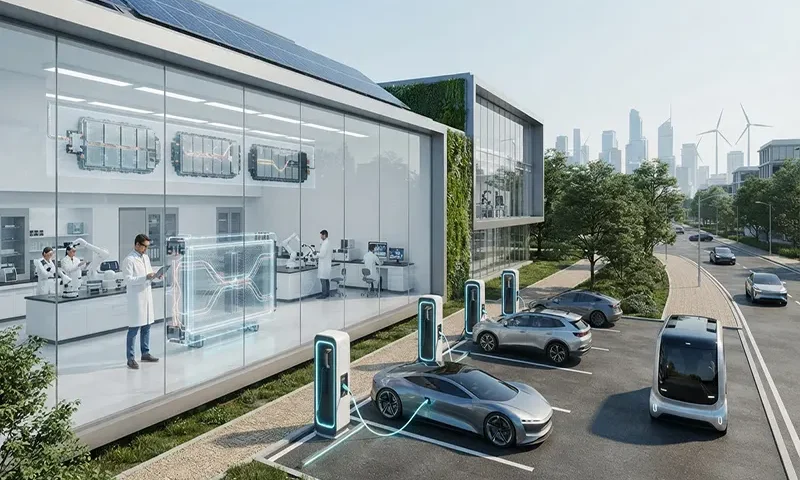
The Energy Density Frontier
The next phase of electric vehicle mass adoption hinges entirely on breaking through legacy lithium-ion energy density ceilings and charging speed bottlenecks. While traditional chemistry has served the industry well, rising consumer expectations and commercial fleet demands require a radical leap in energy storage. Commercial breakthroughs across semi-solid-state electrolytes, silicon-dominant anodes, and megawatt-class charging infrastructure are now converging to eliminate range anxiety and slash refueling times down to parity with internal combustion engines.
Solid-State and Semi-Solid Battery Commercialization
The commercialization roadmap for advanced energy storage has entered a critical execution phase, characterized by a pragmatic shift toward semi-solid (solid-liquid hybrid) architectures.
- The Semi-Solid Bridge: While fully dry, all-solid-state cells remain heavily confined to pilot-line optimization and research labs due to steep production cost premiums and interfacial resistance challenges, semi-solid variants (featuring a 5% to 15% liquid-solid mix) are actively scaling onto vehicle production lines.
- Energy Density and Safety Gains: Leading pack architectures are achieving volumetric energy densities approaching 400 to 500 Wh/kg. This allows automakers to pack extended driving ranges—often exceeding 500 miles—while drastically suppressing thermal runaway risks through enhanced structural stability.
- Manufacturing Scaling: Major tier-one cell makers are aggressively expanding specialized dry-room footprints, with prominent gigafactory investments coming online across Europe and Asia to transition these dense chemistries from prototype status to high-volume manufacturing.
Anode Innovation and Ultra-Fast Charging Chemistries
To support ultra-fast refueling without sacrificing lifespan, battery designers are radically transforming internal cell components, shifting away from pure graphite toward advanced anode innovations.
- Silicon-Composite Anodes: The commercial integration of silicon-dominant and silicon-carbon anodes allows lithium ions to intercalate at unprecedented speeds, bypassing the traditional bottlenecks of lithium plating and dendrite formation during rapid charging events.
- 5C to 6C Charging Rates: Combined with high-voltage architectures operating at 800V to 1,000V, these advanced cells support extreme charging rates (5C to 6C), enabling passenger and commercial vehicles to replenish state-of-charge from 10% to 80% in under 10 minutes.
- All-Climate Performance: Recent winter testing milestones demonstrate that advanced thermal management—including pulse-heating technology—can preserve up to 70% to 80% capacity retention even in extreme sub-zero environments, solving cold-weather range collapse.
Megawatt Charging Networks and Grid Infrastructure Evolution
On the infrastructure side, the rollout of ultra-fast hardware has transitioned from experimental corridors to mainstream commercial deployment, driven heavily by heavy-duty commercial demands and passenger car ultra-fast standards.
- Megawatt Charging Systems (MCS): Formalized under international technical standards like IEC TS 63379, high-power corridors are deploying liquid-cooled charging cables capable of delivering 350 kW to over 1 MW of continuous power.
- Battery Energy Storage Systems (BESS): To prevent local grid transformer overloads and mitigate peak demand pricing, modern charging hubs increasingly incorporate localized stationary battery buffers and integrated photovoltaic (PV) solar arrays.
- Smart Grid Integration: Vehicle-to-Grid (V2G) and Vehicle-to-Home (V2H) protocols are maturing into operational revenue models, turning parked electric fleets into dynamic distributed energy assets that stabilize local power grids during periods of high demand.
Outlook and Strategic Industry Roadmap
Sustaining momentum through the remainder of the decade requires cell manufacturers and charging operators to navigate tight capital constraints while executing flawless supply chain scaling. Achieving cost parity with legacy lithium-ion cells while standardizing high-power communication protocols (such as ISO 15118-20) will determine market survival. Ultimately, the seamless marriage of next-generation semi-solid energy density and megawatt-class charging infrastructure will cement electric mobility as the undisputed global standard for both consumer and commercial transport.

