
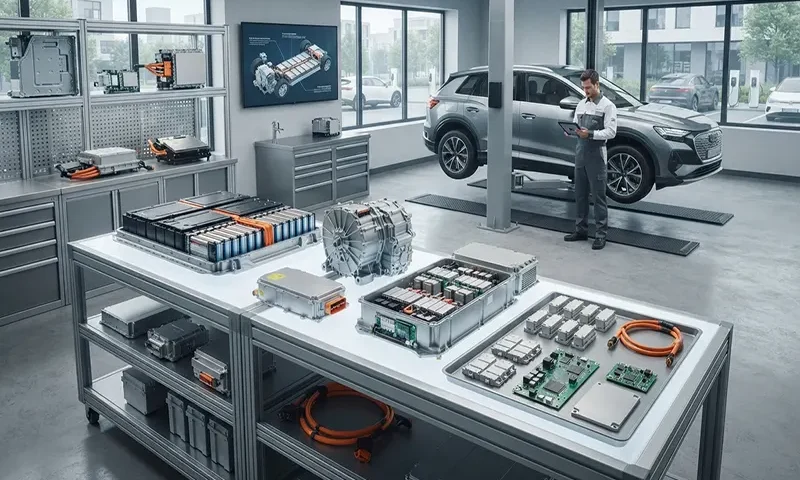
The Evolution of EV Powertrains
As millions of electric vehicles age past their initial factory warranties, automotive service bays are undergoing a profound transformation. Technicians are shifting away from traditional mechanical maintenance toward advanced electronic and high-voltage powertrain component servicing. Within this high-tech ecosystem, the power inverter—operating alongside integrated traction motors and high-voltage distribution assemblies—represents the single most critical high-value replacement category in the modern EV aftermarket.
The Power Inverter: Architecture, Failure Modes, and Silicon Carbide
The power inverter is the computational and switching heart of the electric powertrain, responsible for converting direct current (DC) from the high-voltage battery into variable-frequency alternating current (AC) for the traction motor.
- Silicon-Carbide (SiC) Integration: Modern inverter replacements are rapidly moving away from legacy silicon-based insulated-gate bipolar transistors (IGBTs) toward advanced silicon-carbide (SiC) MOSFET modules. Operating at switching frequencies exceeding 20 kHz and voltage thresholds from 800V to 1,000V, SiC modules slash thermal dissipation losses by up to 50%, significantly boosting real-world driving range.
- Common Failure Modes: Despite robust engineering, inverters frequently experience thermal fatigue in internal solder joints, electrolytic capacitor dry-out, and gate driver microchip burnouts caused by continuous high-current transients.
- Replacement Solutions: Aftermarket replacement parts now feature upgraded thermal interface materials (TIM) and laser-welded busbars designed to eliminate historical stress points and extend operational lifespans.
Traction Motor Assemblies: Stator, Rotor, and Bearing Maintenance
While electric motors contain far fewer moving parts than internal combustion engines, extreme rotational speeds (often exceeding 16,000 RPM) and continuous torque delivery introduce unique mechanical and electromagnetic wear patterns.
- Stator and Rotor Integrity: High-temperature operating environments can degrade stator winding insulation, leading to short circuits. Similarly, permanent magnet rotors require precise balancing and specialized retaining sleeves to prevent demagnetization under heavy thermal loads.
- Bearing Pitting and EDM: A major driver of motor servicing is electrical discharge machining (EDM) across motor bearings. High-frequency shaft voltages discharge through standard steel bearings, pitting the races and causing premature failure. The aftermarket has responded with surging demand for ceramic-hybrid bearings and shaft-grounding brushes.
- Component-Level vs. Unit Swaps: Independent workshops increasingly evaluate whether to perform component-level repairs—such as stator rewinding and resolver sensor replacements—versus executing complete drive-unit swaps.
Thermal Management and High-Voltage Harnessing Replacements
The high-voltage powertrain cannot operate in isolation; it relies on complex supporting infrastructure that frequently requires maintenance and replacement.
- Cooling Loop Degradation: Power inverters and traction motors share aggressive closed-loop cooling circuits operating at specialized dielectric fluid pressures. Electronic water pumps, multi-port thermal control valves, and coolant-sealed cold plates degrade over time, requiring specialized aftermarket replacement kits to prevent localized overheating.
- High-Voltage Cabling and HVIL: Shielded high-voltage cables, electromagnetic interference (EMI) shielding braids, and high-voltage interlock loop (HVIL) connectors are vital consumable components that must be replaced following collision repairs or severe thermal events.
- Diagnostic Protocols: Safely replacing powertrain sub-assemblies requires rigorous high-voltage de-energization protocols, insulated Class 0 tools, and specialized diagnostic scanners capable of clearing hard ECU fault codes and recalibrating resolver positions.
Strategic Outlook and Aftermarket Supply Chain Roadmap
Sustaining profitability in the mature EV service economy through the remainder of the decade hinges on proactive inventory sourcing and intensive technician upskilling. Aftermarket distributors must build reliable pipelines for high-value power electronics, remanufactured inverter assemblies, and certified replacement sensors. Concurrently, independent shops that master high-voltage safety compliance and modular component replacement will capture significant market share, transforming complex electronic repairs into high-margin service revenue.

