
The Synergy of Efficiency
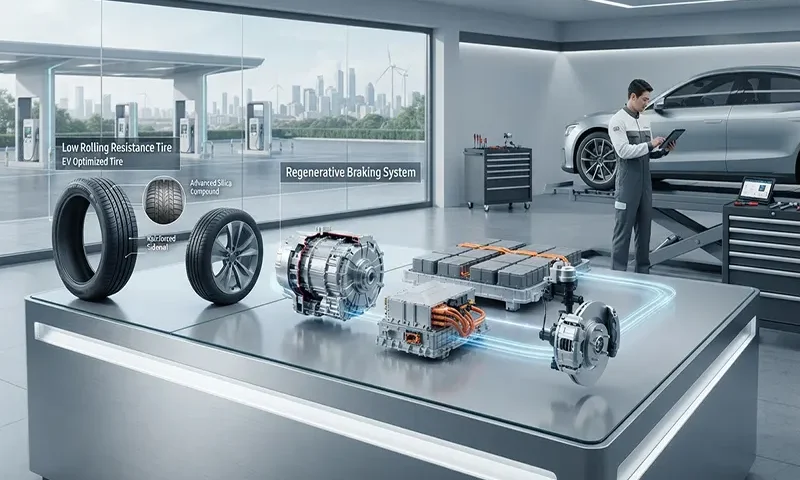
Maximizing electric vehicle range relies fundamentally on minimizing energy loss at the road contact patch and recovering kinetic energy during deceleration. Low rolling resistance (LRR) tires and regenerative braking systems form a dual-pillar efficiency matrix that extends real-world driving range by up to 25% to 30% without requiring larger, heavier battery packs. Understanding the intricate engineering behind these components is vital for optimizing vehicle efficiency, reducing thermal stress, and extending component lifespans.
Low Rolling Resistance Tires: Chemistry, Compounds, and Construction
Tire hysteresis—the energy lost as a tire deforms and recovers under load—accounts for roughly 20% of total vehicle energy consumption. EV-specific LRR tires are engineered to drastically cut this loss.
- Silica-Rich Compounds: Modern LRR tires utilize high-dispersible silica matrices and specialized functionalized polymers that minimize internal friction and heat generation during continuous rolling.
- Structural Reinforcement: To support the heavy mass of high-voltage battery packs, these tires feature reinforced sidewalls and high-load-index casings (such as HL-rated tires) while maintaining a lower profile to reduce aerodynamic drag.
- Balancing Trade-offs: Advanced tread pattern designs use closed-shoulder blocks and optimized siping to overcome historical compromises, delivering low rolling resistance without sacrificing wet-weather traction, cornering grip, or cabin noise standards.
Regenerative Braking Mechanics and Powertrain Integration
When decelerating, electric vehicles harness kinetic energy by reversing the primary function of the drivetrain.
- Generator Inversion: Traction motors instantly switch from propulsion units to electrical generators. The rotational inertia of the wheels forces the rotor past the stator windings, creating a resistive electromagnetic torque that generates electricity.
- Power Conversion Hardware: The generated AC power flows through high-frequency inverter switching modules, which convert it back into controlled DC power via bi-directional DC-DC converters before routing it through the battery management system (BMS) for storage.
- Energy Recovery Rates: Brake-by-wire actuators manage one-pedal driving profiles, successfully capturing up to 20% to 30% of usable kinetic energy while dynamically balancing friction-brake blending during hard stops.
Aftermarket Maintenance, Wear Characteristics, and Component Replacement
The unique operating profile of electric vehicles fundamentally alters traditional wear patterns across the wheel assembly and braking hardware.
- Tire Wear Dynamics: Instant torque delivery and increased vehicle weight cause accelerated tread wear across the outer shoulders of standard tires, making proper wheel alignment and regular rotation cycles critical for LRR tire longevity.
- Friction Brake Corrosion: Because regenerative braking handles the vast majority of deceleration, traditional hydraulic brake pads and rotors experience significantly less friction wear. However, this creates a secondary paradox: surface corrosion, rust pitting, and guide-pin seizing due to underuse, requiring periodic servicing and rotor cleaning.
- Aftermarket Replacement: When replacing LRR tires, technicians must ensure exact OEM load ratings and rolling circumference specs are maintained to prevent adverse effects on traction control systems and speedometer calibration.
Strategic Outlook and the Future of Efficiency Engineering
Sustaining the next generation of efficiency gains requires integrating tire technology directly with vehicle control software. Emerging “smart tire” technologies embed Bluetooth Low Energy (BLE) sensors within the tread to transmit real-time road friction, temperature, and load data directly to the vehicle’s regenerative braking computer. Ultimately, the tight convergence of advanced tire compound chemistry and intelligent kinetic energy harvesting will dictate the ultimate efficiency ceiling of electric mobility.

