
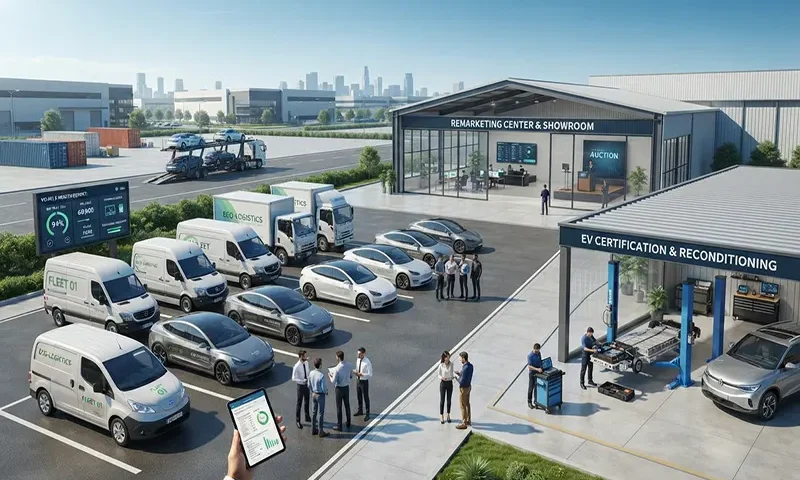
The Fleet Electrification Wave
Early corporate commitments to fleet electrification have reached a critical milestone, with hundreds of thousands of commercial delivery vans, passenger pools, and light utility trucks approaching their first remarketing cycles. Traditional fleet disposal models are proving insufficient for electric vehicles. Maximizing residual value requires specialized battery health transparency, targeted digital remarketing channels, and proactive lifecycle planning to navigate an evolving secondary market.
Residual Value Volatility and Valuation Metrics
Managing depreciation curves for commercial electric vehicles requires moving beyond traditional mileage-and-age appraisals to incorporate real-time operational data.
- Predictive Analytics: Modern fleet operators use telematics data—tracking depth-of-discharge frequencies, fast-charging ratios, and thermal exposure—to forecast accurate residual values long before vehicles hit the auction block.
- Total Cost of Ownership (TCO) Balance: While commercial EVs often carry higher initial acquisition costs, lower per-mile operational and maintenance expenses during their primary service life can offset depreciation hits if remarketing timing is optimized against regional demand.
- Mitigating Value Drops: Fleets insulate themselves against sudden residual drops by establishing continuous battery health baselines and avoiding aggressive multi-shift deep-cycling without adequate thermal mitigation.
Digital Remarketing Ecosystems and B2B Auction Channels
The transition from physical dealer-only lanes to specialized digital B2B remarketing platforms has streamlined how retired commercial assets are liquidated.
- Digital B2B Infrastructure: Specialized digital platforms match retired commercial EVs with secondary markets—such as regional municipal fleets, local delivery contractors, and utility companies—seeking affordable urban electric mobility solutions.
- Certified Inspection Integration: Embedding verifiable State-of-Health (SoH) diagnostics and comprehensive digital vehicle inspection (DVI) reports directly into wholesale listings accelerates inventory turn times by up to 25% and removes buyer hesitation regarding high-voltage pack performance.
- Arbitrage and Geographic Placement: Sophisticated remarketers leverage cross-border and inter-regional data analytics to route commercial assets to geographic zones with high incentives or stringent urban emissions zones, maximizing net recovery values.
Refurbishment, De-Fleet Preparation, and Battery Certification
Preparing commercial EVs for secondary market deployment requires a standardized sequence of physical and digital reconditioning protocols.
- Data Sanitization and Telematics Unlinking: De-fleeting operations must securely wipe corporate cloud telemetry accounts, enterprise routing data, and onboard navigation histories while unlinking commercial software subscriptions.
- Battery Health Validation: Issuing a certified third-party battery health report proves to secondary wholesale buyers that high-voltage packs retain greater than 80% original capacity, safeguarding market pricing integrity.
- Cosmetic and Structural Reconditioning: Stripping corporate wraps, repairing box-truck composite panels, and reconditioning high-wear cabin touchpoints ensure units meet standard wholesale grading thresholds.
Strategic Outlook and Long-Term Fleet Roadmap
Sustaining capital efficiency through the remainder of the decade demands that fleet operators treat remarketing as an active, data-driven discipline rather than an afterthought. Organizations that integrate proactive battery tracking, agile digital disposition channels, and certified health documentation will successfully unlock maximum liquidity from their retiring electric fleets. Ultimately, advanced remarketing strategies will dictate corporate profitability in the zero-emission logistics era.

