

Understanding a Diversified Infrastructure Conglomerate Before You Invest
Few corporate groups in India spark as much discussion on trading desks and at family dinner tables as this one. Investors who track Adani Shares usually do so because the group touches ports, power, airports, roads and energy, sectors tied closely to the country’s development story. When people want a view on the flagship company that incubates new ventures, they often check the Adani Enterprises share price and hope that one number will explain a complicated business. It cannot, and this article explains how to build a fuller picture.
The Incubator Model Explained
The flagship company follows unorthodox, multi-sectoral development. Its growth narrative involves building new businesses, waiting till they pass the initial cash-drain phase, and then listing or demerging them. As a result, the flagship has separate listed entities for its ports, power transmission, renewable energy, gas distribution and cement.
For an investor, this presents two issues. Firstly, earnings … Continue reading >>>>

Profitable Business Opportunities in the Growing Second-Hand Electric Car Market
The Secondary Market Gold Rush
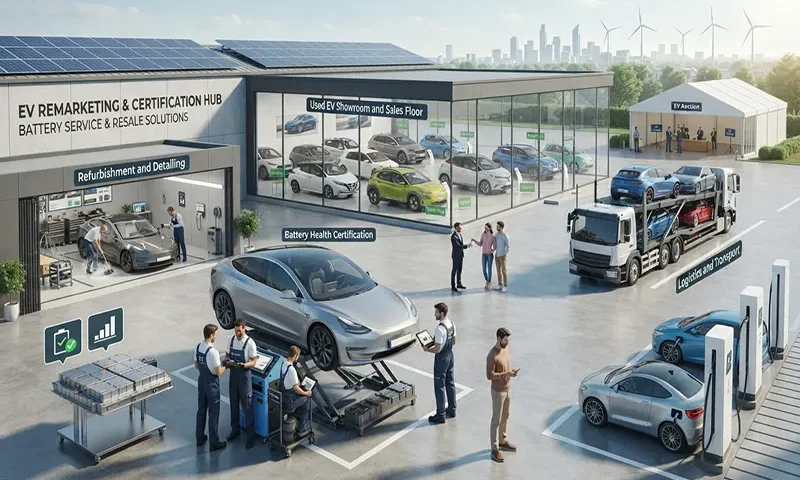
As millions of early-lease and retail electric vehicles flood the secondary market, a multi-billion-dollar economic opportunity is opening up for agile businesses capable of solving used-EV friction points. Profitability in the pre-owned EV space no longer relies on traditional high-volume flipping; instead, it is anchored in specialized technological services, data transparency platforms, and comprehensive lifecycle management that eliminate consumer uncertainty and streamline dealer inventory.
Independent Battery Health Certification and Diagnostics Labs
The single greatest point of friction in the pre-owned EV market is quantifying the remaining capacity and degradation rate of the high-voltage pack. This creates a high-margin service opportunity for independent diagnostics labs.
- B2B Certification Services: Establishing mobile diagnostic units or dedicated testing facilities that issue certified State-of-Health (SoH) reports allows operators to charge premium per-inspection fees to independent dealerships and auction houses.
- Eliminating Buyer Hesitation: Verifiable health audits protect buyers from asymmetric information
Low Rolling Resistance Tires and Regenerative Braking System Parts for Electric Cars
The Synergy of Efficiency
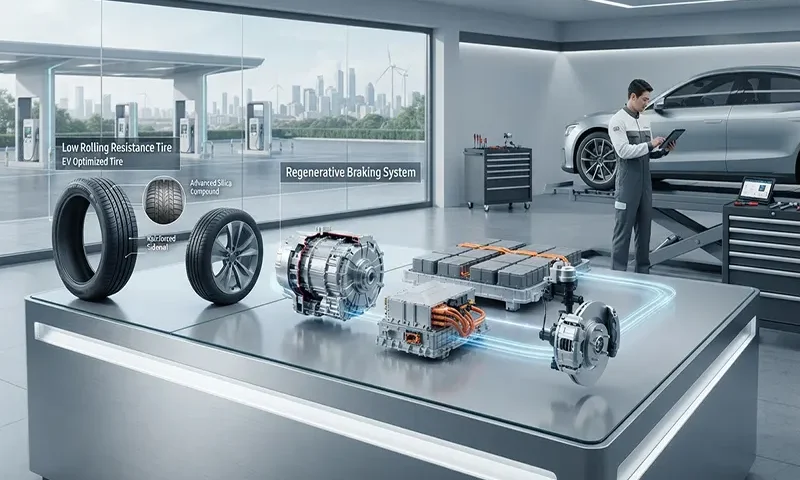
Maximizing electric vehicle range relies fundamentally on minimizing energy loss at the road contact patch and recovering kinetic energy during deceleration. Low rolling resistance (LRR) tires and regenerative braking systems form a dual-pillar efficiency matrix that extends real-world driving range by up to 25% to 30% without requiring larger, heavier battery packs. Understanding the intricate engineering behind these components is vital for optimizing vehicle efficiency, reducing thermal stress, and extending component lifespans.
Low Rolling Resistance Tires: Chemistry, Compounds, and Construction
Tire hysteresis—the energy lost as a tire deforms and recovers under load—accounts for roughly 20% of total vehicle energy consumption. EV-specific LRR tires are engineered to drastically cut this loss.
- Silica-Rich Compounds: Modern LRR tires utilize high-dispersible silica matrices and specialized functionalized polymers that minimize internal friction and heat generation during continuous rolling.
- Structural Reinforcement: To support the heavy mass of high-voltage battery packs, these tires

Automotive Manufacturer Financial Performance and Market Forecast Updates
The 2026 Macroeconomic Reality
The global automotive sector operates in a fragmented, highly regionalized, and cost-constrained environment marked by uneven electric vehicle (EV) adoption and shifting trade protectionism. While top-line unit sales remain stable near 91.8 million units globally, a sharp divergence between revenue generation and operating profitability is forcing automakers to radically overhaul their capital deployment and cost structures.
OEM Profitability Pressures and EBIT-Per-Vehicle Metrics
Recent financial performance tracking reveals that the operational profitability of major global manufacturers has contracted significantly.
- Margin Compression: The average group earnings before interest and taxes (EBIT) per vehicle delivered dropped roughly 16% to approximately 1,187 euros, while overall industry EBIT margins slipped to an average of 3.3%.
- Root Causes: This margin erosion is driven by aggressive retail price wars, slowing consumer uptake of battery electric vehicles (BEVs) in Western markets, and expensive platform realignment outlays.
- Legacy vs. Pure-Play Strain: Traditional legacy players face

How to Select the Right Location for an EV Charging Station
Installing an EV charger is only half the equation; the location determines whether it will actually be used. Whether you’re a commercial property owner, Resident Welfare Association (RWA), fleet operator, or business looking to attract EV drivers, choosing the right site is critical for long-term success.
While many people focus on selecting the best EV charger, the most successful charging stations combine reliable hardware with strategic placement, adequate electrical infrastructure, and convenient access. In India’s rapidly growing EV ecosystem, location planning can significantly influence charger utilization, operating costs, and user experience.
Start with User Demand, Not Just Available Space
A common mistake is installing chargers wherever there is vacant parking. Instead, identify where EV drivers naturally spend time.
High-potential locations include:
- Apartment complexes
- Office buildings
- Shopping malls
- Hotels
- Restaurants
- Hospitals
- Fuel stations
- Highway rest stops
The goal is to place chargers where vehicles are already parked for the amount … Continue reading >>>>