

Commercial Fleet Used Electric Vehicle Remarketing and Resale Strategies
The Fleet Electrification Wave
Early corporate commitments to fleet electrification have reached a critical milestone, with hundreds of thousands of commercial delivery vans, passenger pools, and light utility trucks approaching their first remarketing cycles. Traditional fleet disposal models are proving insufficient for electric vehicles. Maximizing residual value requires specialized battery health transparency, targeted digital remarketing channels, and proactive lifecycle planning to navigate an evolving secondary market.
Residual Value Volatility and Valuation Metrics
Managing depreciation curves for commercial electric vehicles requires moving beyond traditional mileage-and-age appraisals to incorporate real-time operational data.
- Predictive Analytics: Modern fleet operators use telematics data—tracking depth-of-discharge frequencies, fast-charging ratios, and thermal exposure—to forecast accurate residual values long before vehicles hit the auction block.
- Total Cost of Ownership (TCO) Balance: While commercial EVs often carry higher initial acquisition costs, lower per-mile operational and maintenance expenses during their primary service life can offset depreciation hits if remarketing timing is

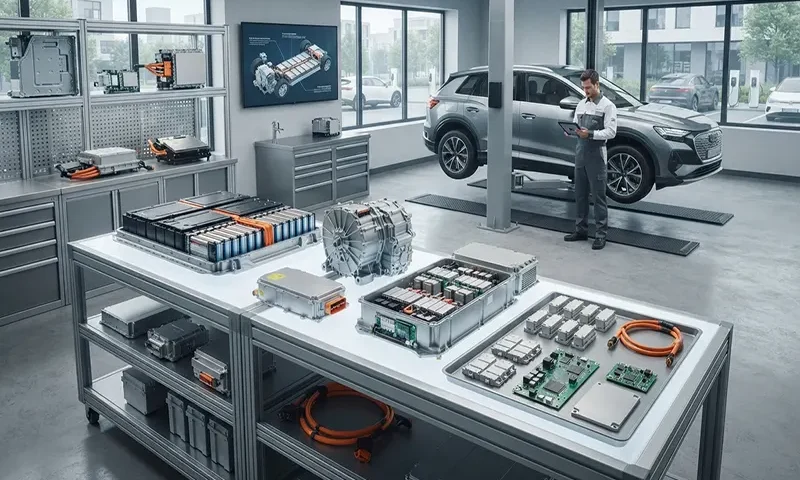
Electric Vehicle Powertrain Components and Power Inverter Replacement Parts
The Evolution of EV Powertrains
As millions of electric vehicles age past their initial factory warranties, automotive service bays are undergoing a profound transformation. Technicians are shifting away from traditional mechanical maintenance toward advanced electronic and high-voltage powertrain component servicing. Within this high-tech ecosystem, the power inverter—operating alongside integrated traction motors and high-voltage distribution assemblies—represents the single most critical high-value replacement category in the modern EV aftermarket.
The Power Inverter: Architecture, Failure Modes, and Silicon Carbide
The power inverter is the computational and switching heart of the electric powertrain, responsible for converting direct current (DC) from the high-voltage battery into variable-frequency alternating current (AC) for the traction motor.
- Silicon-Carbide (SiC) Integration: Modern inverter replacements are rapidly moving away from legacy silicon-based insulated-gate bipolar transistors (IGBTs) toward advanced silicon-carbide (SiC) MOSFET modules. Operating at switching frequencies exceeding 20 kHz and voltage thresholds from 800V to 1,000V, SiC modules slash thermal dissipation

Upcoming Electric Car Launches: Price Updates and Performance Specs
The 2026 EV Launch Landscape
The global automotive market is experiencing a massive wave of new electric vehicle introductions, driven by intensified price competition and aggressive platform sharing among original equipment manufacturers (OEMs). Automakers are pivoting toward aggressive pricing transparency, longer range capabilities, and ultra-fast charging architectures to capture mainstream buyers. With battery pack manufacturing costs dropping significantly over the past year, the newest crop of showroom arrivals bridges the gap between early-adopter luxury and high-volume commercial accessibility.
Affordable Mass-Market Entries and Price Corrections
A major focus of current launches is the sub-$35,000 to $40,000 segment, where scale and lithium-iron-phosphate (LFP) battery integration are driving down entry-level price points.
- Budget-Friendly Segments: New urban crossovers and hatchbacks—such as upcoming entries from traditional volume brands—are targeting the $25,000 to $30,000 threshold to directly challenge internal combustion engine alternatives.
- Price Realignment: To stimulate demand amid shifting regulatory incentives, major manufacturers have introduced sticker

Software Defined Vehicle Market Insights and Automotive Tech News
The Centralized Computing Paradigm
The automotive industry has crossed a decisive structural threshold, moving definitively away from distributed, single-function electronic control units (ECUs) toward centralized domain and zonal computing architectures. Valued at over $600 billion globally, Software-Defined Vehicles (SDVs) are no longer viewed as experimental concepts. Instead, they represent the core operational determinant of vehicle valuation, user experience, and long-term recurring revenue streams for both legacy original equipment manufacturers (OEMs) and electric vehicle pure-plays.
Zonal E/E Architectures and Silicon Convergence
The structural migration from dozens of isolated microcontrollers to high-performance zonal controllers and central compute clusters is redefining physical vehicle design.
- Hardware and Software Decoupling: By routing local sensors and actuators through 4 to 6 regional zone controllers connected via multi-gigabit automotive Ethernet backbones, automakers are cutting wiring harness lengths by up to 60%, drastically reducing vehicle curb weight.
- High-Performance SoCs: Advanced system-on-chips (SoCs) equipped with integrated AI accelerators now
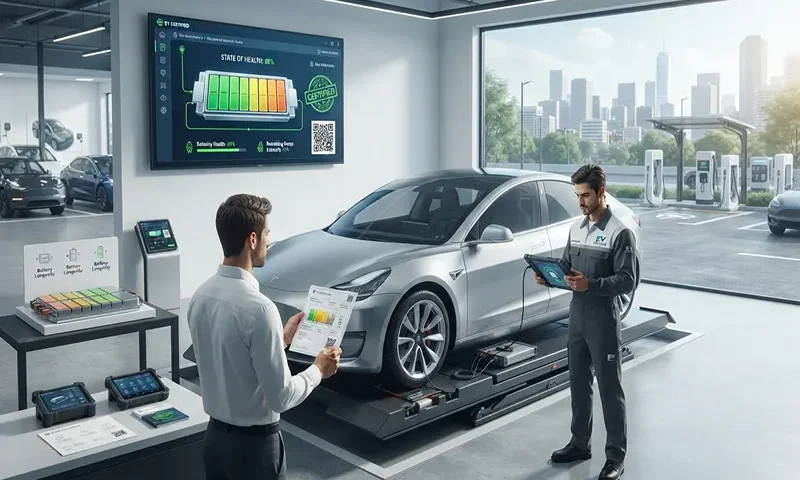
Pre-Owned Electric Vehicle Battery Health Certification Business Model
The Secondary Market Trust Deficit
The secondary electric vehicle market is scaling at an unprecedented rate as millions of early-lease returns and trade-ins flood dealer lots. Yet, a persistent trust deficit—driven by consumer range anxiety and profound uncertainty over high-voltage battery health—continues to create friction in used car transactions. Unlike internal combustion engines, where mechanical wear is visibly assessed through mileage and oil analysis, a battery’s internal degradation is invisible to the naked eye. Institutionalizing a transparent, certified battery health business model is the critical catalyst required to unlock market liquidity, streamline trade-in appraisals, and establish reliable residual value forecasting across the global automotive sector.
The Diagnostics Technology Stack and SoH Protocols
Establishing absolute buyer confidence requires moving far beyond basic, surface-level onboard diagnostics (OBD-II) toward advanced, cloud-connected telemetry and rigorous state-of-health (SoH) profiling.
- Advanced Diagnostic Mechanics: Modern certification platforms utilize a combination of rapid charge-discharge stress testing, micro-cycle analysis,